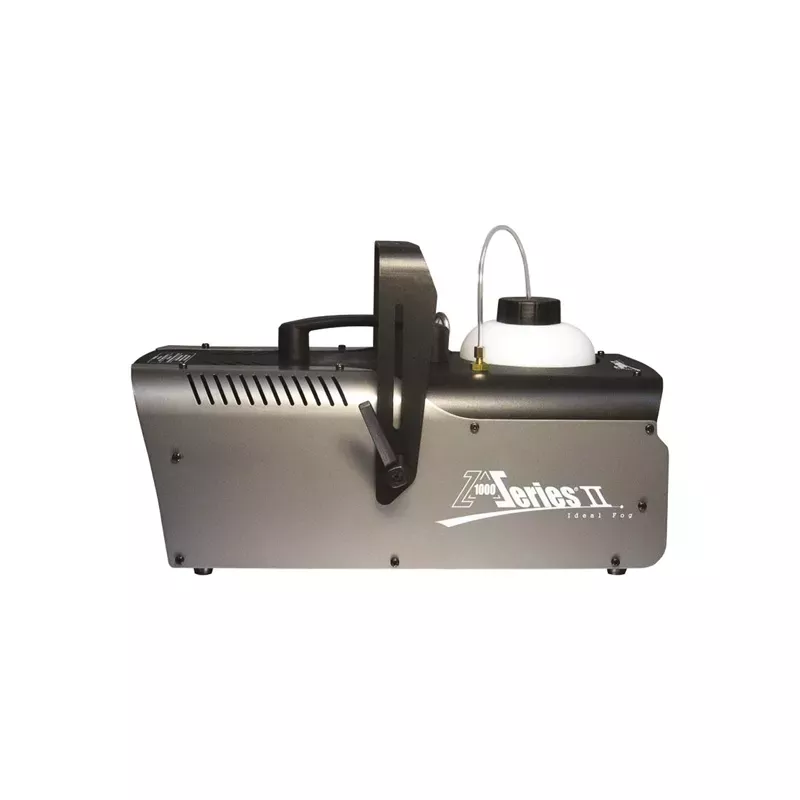
F1000 smoke generator (1000 W) – the professional standard for leak detection
When you’re searching for leaks, you’re not looking for “just another device” — you’re looking for reliable, visible, and repeatable proof. The F1000 Smoke Generator delivers exactly that: a dense, consistent, high-volume smoke output ideal for building diagnostics, HVAC testing, and network leak detection. Engineered for both technical diagnostics and visual effects, it combines fast heat-up time, high airflow, and fine particle smoke, making it equally effective for airtightness testing and stage or film use.
Why choose the F1000 smoke generator ?
A professional smoke generator isn’t judged by wattage alone — it’s about control, stability, and usability in the field.
On-site, performance is measured by its ability to :
- Accelerate leak detection and reduce downtime.
- Maintain constant temperature for consistent smoke density.
- Adapt to challenging environments (dust, ceilings, ducts, wind).
- Operate safely and efficiently in confined or remote spaces.
- Be portable, robust, and easy to handle.
The F1000 meets all these requirements thanks to its intelligent design :
- High output ≈ 150 m³/min: Quickly saturates a room or duct — leaks become visible within seconds.
- Fast preheating ≈ 4–5 min: Ready for immediate use on dynamic field operations.
- High-density smoke: Clear visibility of airflow and leaks without oily residue.
- Dual control (wired + wireless): Operate remotely while monitoring the smoke flow in real time.
- Portable design (3.5 kg with bracket): Lightweight and easy to carry, hang, or angle during testing.
Key technical features explained
1000 W heating power – stable and efficient performance
The internal heater block delivers consistent, fine-particle smoke. At 1000 W, warm-up takes about 4–5 minutes, then stabilizes for repeatable cycles without overheating or performance loss.
Airflow ≈ 150 m³/min – rapid volume saturation
The smoke output determines how fast a test volume fills. At around 150 m³/min, a 50 m³ space reaches a readable fog level in about 20–30 seconds (depending on ventilation). In duct systems, this output ensures visible leaks without moving the machine between junctions.
Effective range ≈ 7 m indoors
With an indoor reach of ~7 m, the generator can be positioned away from the test zone — reducing repositioning time. In outdoor or windy conditions, work upwind and reduce output intervals for better visibility.
Tank capacity 1.2 L | Fluid consumption 0.5–1.0 L/h
The 1.2 L tank supports 1–2 hours of intermittent testing. Consumption depends on the fluid type (standard or high-density), cycle mode (continuous or pulsed), and ventilation conditions.
Dual remote control and LED indicators
- Wired remote (3 m): Safe, immediate activation.
- Wireless remote: Operate remotely while inspecting leak zones.
- LED status indicators: Heating / Ready / Low fluid level — prevents cold starts and wasted time.
Noise level ≈ 70–75 dB at 1 m — equivalent to a loud conversation. Recommended operating cycle: 3–5 min ON / 2–3 min OFF to protect the pump and improve smoke readability.
Leak detection applications – Step-by-step method
A smoke generator makes diagnostics objective and visual, without dismantling. The smoke reveals weaknesses — joints, cracks, seals, connections, traps, or faulty covers — by following preferential air or gas paths.
Example: Wastewater or ventilation network testing (EU/EV/EP)
1. Preparation
- Seal unused outlets with inflatable plugs to prevent unwanted smoke escape.
- In indoor setups, disable smoke detectors temporarily and inform the operator.
- Plan safety measures (PPE, signage, post-test ventilation).
2. Installation
- Place the smoke generator upstream or downstream, depending on access.
- Connect a flexible hose (Ø 20–30 mm typical) at the injection point and check for tightness.
- Use the mounting bracket for stable positioning — ensure no obstruction in front of the nozzle.
3. Injection
- Start-up: Full power for 60–90 seconds to prime the network.
- Sustain phase : Reduce to ~50 % output for clear, steady smoke.
- Cycle: 3–5 min ON / 2–3 min OFF. Monitor temperature and visibility.
4. Observation
- The first smoke emergence reveals the leak point: joint, cover, junction, or slab opening.
- Record photos or video evidence, note distances, and document the test route.
5. Validation & Purge
- Stop injection, let the network vent, and air out the test area.
- Flush the hose and clean the generator after intensive use.
Pro tip: For long sections, proceed zone by zone (≈ 40–80 m). Test, mark the leak, isolate, and move forward — improving accuracy and efficiency.
Other professional use cases
Ventilation & HVAC systems
Inject smoke from the fan side — check exhaust vents, door gaps, and returns. A visible backflow indicates imbalance or duct leakage.
Technical ducts & Galleries
The smoke follows airflow paths — an unexpected emergence signals defective seals or penetrations.
Plenums & False ceilings
Apply slight overpressure to visualize air leaks at light fixtures, panels, and access hatches. Useful for mapping diffuse infiltration zones.
Stage and film applications – Clean, even fog output
The F1000 also performs perfectly for stage, photography, and filming. It produces a uniform, stable fog that enhances lighting effects (beams, spots, washes) without leaving oily residues.
- Small to medium venues: ~7 m reach; easy setup via mounting bracket or truss.
- Film and photo studios: fine texture, consistent dispersion for multiple takes.
- Large halls or industrial sets: powerful enough for fog layering or smoke effects.
Choosing the right smoke fluid : standard vs high density
The smoke fluid determines texture, visibility, and persistence — optimizing it saves both time and fluid.
| Type |
Composition |
Effect |
Ideal Use |
| Standard |
Glycol base |
Quick diffusion, short hold |
Stage, photography, small volumes |
| High Density |
Glycol + glycerin |
Longer hold, thicker plume |
Leak detection, large volumes, outdoor use |
- Always use manufacturer-approved fluids — avoid scented or non-compatible liquids (risk of residue or clogging).
- Match the fluid density to your working environment (use high-density for windy conditions).
- Record average fluid use per test for logistical planning.
The F1000 Smoke Generator gives professionals a clear, visual, and fast diagnostic solution in a compact, reliable, and field-ready format. Whether for airtightness testing, leak detection, or visual effects, it combines precision, endurance, and usability — a true benchmark for both technicians and lighting professionals.