





• Our selection
  • Pool leak detector – Single pack | Fluotracking
  • Pool leak detector – Single pack | Fluotracking
  • Pool leak detector – Single pack | Fluotracking
  • Pool leak detector – Single pack | Fluotracking
  • Pool leak detector – Single pack | Fluotracking
Pool leak detector – Single pack | Fluotracking
search
Ref DF020

Pool leak detector - Single pack

€250.00 (tax excl.)

Quickly detect and repair pool leaks with simple methods and an effective leak detector

  • SAV
  • Secure payment
  • Delivery in 24/48 hours

Vidéo Pool leak detector - Single pack

How can you effectively detect a leak in your pool ?

Have you noticed an unusual drop in your pool's water level? A leak may be the cause, and it is essential to act quickly to avoid costly damage. Find out how to easily detect a leak in your pool using simple techniques and a high-performance leak detector.

The telltale signs of a leak in your pool

  • An unusual drop in water level, even outside periods of high heat.
  • Unexplained puddles of water around the pool, often located near skimmers or fittings.
  • Excessive consumption of chemicals, which may indicate that water is leaking continuously and needs to be replaced.
  • Cloudy water despite regular maintenance, a sign that water circulation is disrupted.
  • Air bubbles in the filtration system, which may indicate air intake due to a leak in the pipes.
  • Visible deterioration of seals and fittings, sometimes with abnormal traces of moisture.
  • Fluctuating pressure in the filtration system, indicating an imbalance caused by a leak.
  • Sinking of the ground around the pool or coping stones gradually coming loose, indicating a water leak under the structure.
  • An increase in your water bill, which may indicate a constant, unidentified leak.
  • Abnormal noise in the pipes, such as hissing or gurgling, which may indicate air being sucked in due to a leak.

Why detect a leak quickly ?

Ignoring a leak can have serious consequences: damage to the pool structure, excessive water consumption, and increased maintenance costs. The earlier a leak is detected, the easier and cheaper it is to fix.

Traditional leak detection methods

  • The bucket test: A simple way to compare natural evaporation and a leak.
  • Visual inspection: Check for seals, nozzles, and visible cracks.
  • Tracer dye: A colored product allows you to follow the leak in the water.
  • Acoustic listening: To locate leaks in pipes.

The pool leak detector - The ultimate solution

A leak detector is the ideal tool for quickly and accurately locating any anomalies in your pool. It works on the principles of water displacement and pressure analysis.

How does a leak detector work ?

  1. It is submerged in the pool to analyze pressure variations.
  2. It detects abnormal water flow indicating a potential leak.
  3. It provides an accurate diagnosis so you can take effective action.

Why choose a leak detector ?

  • Saves time : Quick diagnosis without draining the pool.
  • Money savings : Avoids the need for costly professional intervention.
  • Ease of use : Accessible to both individuals and experts.
  • Reliability : Increased accuracy to avoid diagnostic errors.

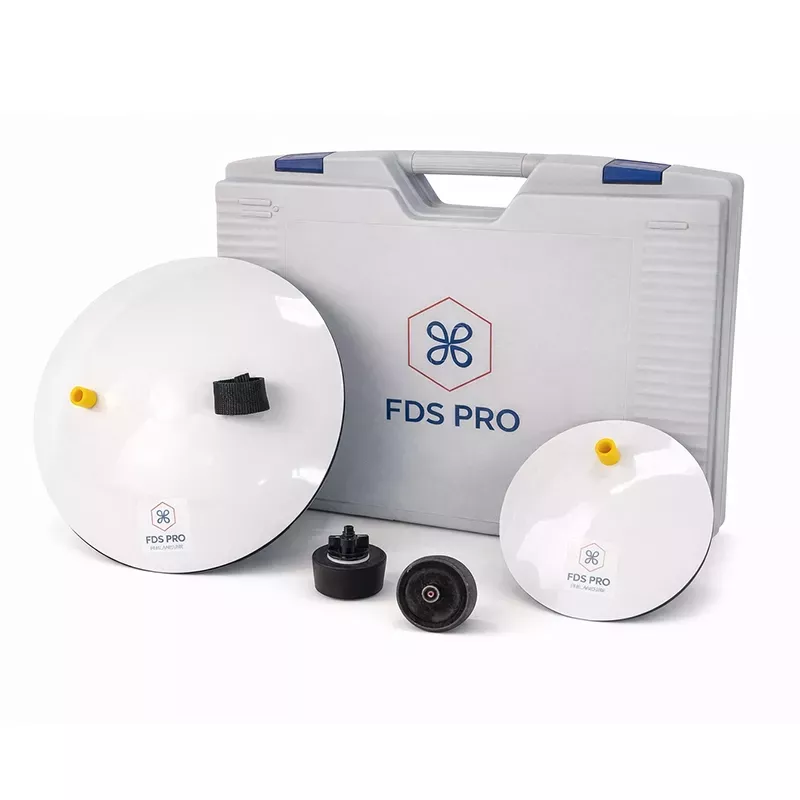
Pool leak detector pack contents

  • A case
  • 1 detector
  • 2 domes (diameter 180 mm and 340 mm)
  • Made in France
  • 2-year warranty

For an immediate visual diagnosis, explore our other pool kits (UV lamp + tracer dye).

Pool leak detector - Single pack : the FAQ

Oui. Le pack est conçu pour repérer les micro-perforations, petites déchirures ou coutures fragilisées du liner. Pour les grandes piscines ou réseaux hydrauliques complexes, le pack pro est plus adapté.

Oui. Le test se fait entièrement sous l’eau, sans vidange et sans abaisser le niveau du bassin. C’est l’un des grands avantages de ce type d’outil.

Non. Le pack simple est conçu pour les fuites localisées dans le bassin. Pour les tuyaux, on utilise plutôt un test de pression, un traceur coloré ou un ballon obturateur.

Oui. Il fonctionne sur toutes les surfaces tant que le détecteur peut être appliqué à quelques millimètres du point suspect. Sur carrelage, l’aspiration reste très visible.

Un mouvement d’eau très clairement orienté vers l’embout du détecteur confirme la fuite. S’il n’y a pas d’aspiration visible, la zone est saine ou la fuite se trouve ailleurs.

Non. Pour obtenir une lecture fiable, la filtration doit être coupée afin d’avoir une eau parfaitement calme.

Oui. Sa précision en fait un outil efficace pour les fuites sur petits volumes, où les micro-perforations sont mais provoquent des pertes d’eau importantes.

Non. Il s’utilise facilement : couper la filtration, se rapprocher de la zone suspecte, approcher l’embout à quelques millimètres, observer la direction de l’eau. Mais pour les fuites complexes ou multiples, un technicien peut être utile.